
If you've ever started a new habit with all the motivation in the world — only to abandon it two weeks later — you're not broken. You're experiencing a well-documented neurological phenomenon, and it has nothing to do with your character.
Most habit advice is built on a flawed assumption: that sustained change comes from sustained motivation. But neuroscience research tells a fundamentally different story.
The Prefrontal Cortex Problem
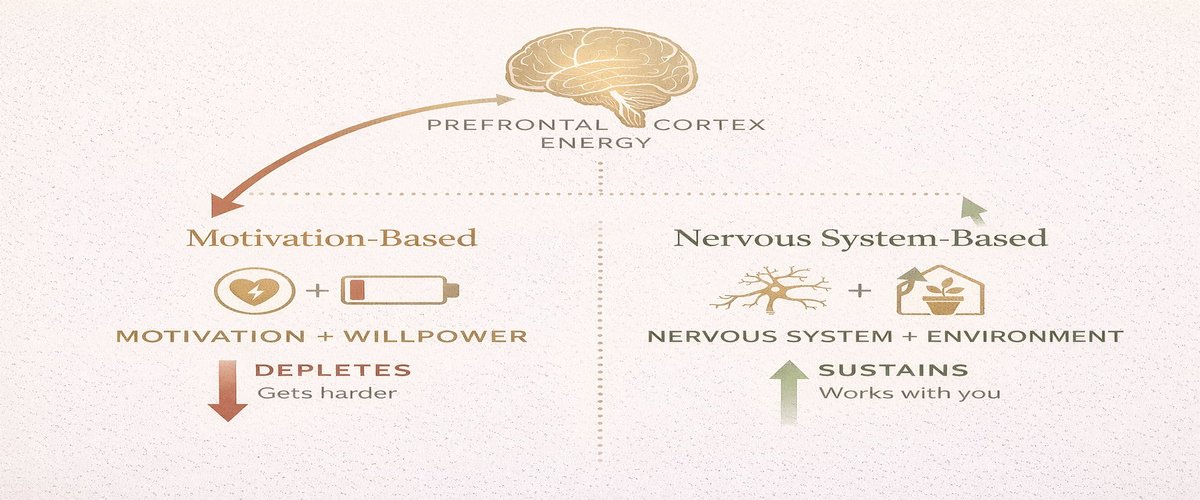
Willpower lives in the prefrontal cortex — the part of your brain responsible for executive function, impulse control, and decision-making. The issue is that this region operates on a limited energy budget. Every decision you make, every impulse you resist, every temptation you navigate draws from the same neurochemical reserves.*
Research from Roy Baumeister's ego depletion studies demonstrated that self-control operates like a muscle that fatigues with use.* While the exact mechanisms are still debated in the scientific community, the practical reality is consistent: relying on conscious effort for behavior change is fighting an uphill battle against your own biology.*
Why Your Nervous System Matters More Than Your Motivation
Here's what shifted my understanding of habit formation: your autonomic nervous system determines which behaviors feel possible in any given moment.*
When you're in a sympathetic state — what most people know as "fight or flight" — your brain deprioritizes long-term planning in favor of immediate survival responses. This isn't a conscious choice. It's your nervous system doing exactly what it evolved to do.*
The problem? Modern life keeps many of us locked in low-grade sympathetic activation. Chronic stress, disrupted sleep, constant digital stimulation — these maintain a baseline state where building new habits feels genuinely harder. Not because you lack discipline, but because your nervous system is allocating resources toward threat management instead of behavior change.*
You can't willpower your way out of a dysregulated nervous system. You have to regulate first, then build.
Where Habits Actually Live in Your Brain
When researchers study habit formation at a neurological level, they find something revealing: established habits don't live in the prefrontal cortex at all. They move to deeper brain structures that operate largely outside conscious awareness.*
This is why you can drive home on autopilot or brush your teeth while thinking about something else entirely. The behavior has been encoded at a level that doesn't require willpower. It's automatic.*
The goal of effective habit formation isn't to sustain motivation. It's to move behaviors from effortful conscious control to automatic, deeper processing. And that process has specific neurological requirements that most habit advice completely ignores.*
What Actually Works
Based on the research, effective habit formation requires three things that motivation-based approaches rarely address:
Nervous system regulation. You need to be in a parasympathetic-dominant state for your brain to allocate resources toward new pattern formation. Specific protocols — like controlled breathing patterns, stress release techniques, and calming exercises — can shift your nervous system state in minutes.*
Timing matters. Your brain has specific windows where it's most receptive to forming new patterns. Understanding and leveraging these windows — which research suggests are influenced by factors like sleep timing, physical activity, and focused attention — can accelerate how quickly new behaviors become automatic.*
Done relying on willpower? The free Calm Start Kit gives you 3 body-first tools to use when motivation isn't enough — or get The Calm Sleep Reset for the complete routine.
Repetition within the right state. It's not just about doing the behavior repeatedly. It's about doing it while your nervous system is in a state that supports encoding. Stressed repetition and regulated repetition produce fundamentally different neurological outcomes.*
This is the core of the Better Life Habits approach. Not more motivation. Not more discipline. Just a clearer understanding of how your brain actually forms new patterns — and practical protocols to work with that biology instead of against it.*
Stop Fighting Your Biology. Start Working With It.
The Calm Sleep Reset replaces willpower with biology — a complete 7-day protocol built on behavioral sleep science principles recommended by the American College of Physicians.
Sources & Further Reading
- Baumeister, R. F., Bratslavsky, E., Muraven, M., & Tice, D. M. (1998). Ego depletion: Is the active self a limited resource? Journal of Personality and Social Psychology, 74(5), 1252–1265.
- Graybiel, A. M. (2008). Habits, rituals, and the evaluative brain. Annual Review of Neuroscience, 31, 359–387.
- Wood, W. & Rünger, D. (2016). Psychology of habit. Annual Review of Psychology, 67, 289–314.
- Duhigg, C. (2012). The Power of Habit. Random House.
*Educational content only. Not medical, psychological, or therapeutic advice. Routines shared for informational purposes. Consult healthcare professionals before making health changes. Individual results vary. References to research are for educational context; Better Life Habits does not claim clinical validation of its specific protocols.