You've probably heard that dopamine is the "reward chemical" — the thing that makes habits stick. That's partially true. But the way most people try to use rewards to build habits actually undermines the exact neurological process they're trying to create.*
Understanding how dopamine actually works in habit formation changes everything about how you approach behavior change.
Dopamine Isn't About Pleasure — It's About Prediction
The biggest misconception about dopamine is that it rewards you after you do something good. Research from Wolfram Schultz and others suggests dopamine is primarily a prediction signal — it fires in anticipation of a reward, not in response to one.*
This distinction matters enormously. Your brain doesn't strengthen habits because they felt good afterward. It strengthens them because it learned to predict that they would lead to something valuable.*
When a reward is unexpected, dopamine spikes. When a predicted reward arrives on schedule, dopamine stays flat. And when an expected reward doesn't show up, dopamine drops below baseline — creating what researchers call a "prediction error."*
Why External Rewards Backfire
Here's where most habit advice goes wrong. The common recommendation is to reward yourself after completing a habit — treat yourself to something nice after a workout, check a box on a habit tracker, give yourself a gold star.*
The problem: external rewards can actually prevent the habit from becoming automatic. When you add an extrinsic reward, your brain may associate the dopamine signal with that reward rather than with the behavior itself. Remove the reward, and the motivation disappears — because the habit never developed its own intrinsic dopamine signature.*
The goal isn't to feel rewarded after a habit. It's to build a brain that anticipates reward from the habit itself.
Tired of bribing yourself into habits? The free Calm Start Kit gives you 3 practices that work with your brain's natural reward system — or get The Calm Sleep Reset for the complete 7-day sleep-support routine.
The Dopamine Anticipation Loop
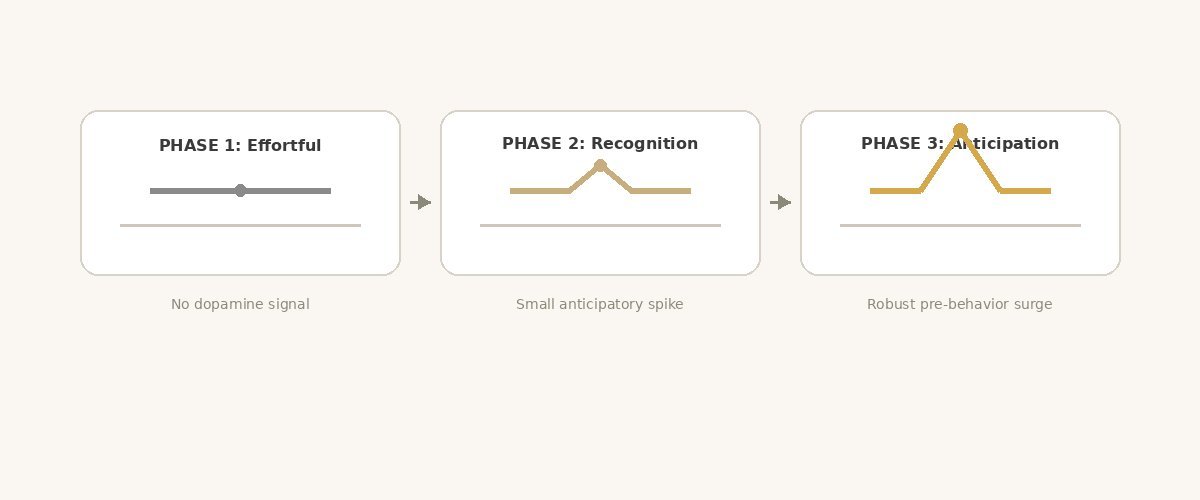
Research suggests that sustainable habits develop their own anticipatory dopamine response over time. Here's what that looks like neurologically:*
Phase 1: Effortful. The behavior requires conscious effort. There's no automatic dopamine response. This is where most people quit — mistaking the absence of motivation for failure.*
Phase 2: Recognition. Your brain begins to associate the cue with the behavior. Small dopamine signals start appearing before the action, not after. You start to feel a slight pull toward the habit.*
Phase 3: Anticipation. The cue alone triggers a robust dopamine response. You feel drawn to the behavior. The habit is becoming automatic — not because you've been rewarded, but because your brain has learned to predict value.*
How to Work With Dopamine, Not Against It
Focus on the process, not the reward. During the behavior itself, bring your attention fully to what you're doing. Research from Andrew Huberman suggests that subjective engagement during an activity may enhance the dopamine association with the activity itself.*
Keep the environment consistent. Same time, same place, same cue. Dopamine prediction requires consistent patterns. Random scheduling prevents your brain from building anticipatory responses.*
Avoid reward substitution. Don't pair new habits with treats, phone time, or other unrelated rewards. Let the behavior develop its own neurochemical identity.*
Expect the dip. There's a period between "motivated by novelty" and "driven by anticipation" that feels like nothing. This isn't failure — it's the gap where your brain is building the prediction circuit. Most people quit here.*
Protect your baseline dopamine. Chronic overstimulation from social media, sugar, or other high-dopamine activities may raise your baseline threshold, making it harder for subtle habits to generate their own signal. Periodic dopamine "fasting" — reducing high-stimulation inputs — may help restore sensitivity.*
This is why Better Life Habits protocols emphasize consistent timing and focused attention rather than reward systems. We're not trying to trick your brain into compliance. We're building the neurological infrastructure for automatic behavior.*
Work With Your Brain's Reward System — Not Against It
The Calm Sleep Reset uses behavioral sleep science to build habits that stick without external rewards. Your nervous system learns to anticipate calm instead of chasing it.
Sources & Further Reading
- Schultz, W. (2016). Dopamine reward prediction error signalling: A two-component response. Nature Reviews Neuroscience, 17(3), 183–195.
- Huberman, A. (2021). Controlling your dopamine for motivation, focus and satisfaction. Huberman Lab Podcast, Episode 39.
- Berridge, K. C. & Robinson, T. E. (2016). Liking, wanting, and the incentive-sensitization theory of addiction. American Psychologist, 71(8), 670–679.
- Wise, R. A. (2004). Dopamine, learning and motivation. Nature Reviews Neuroscience, 5(6), 483–494.
*Educational content only. Not medical, psychological, or therapeutic advice. References to neuroscience research are for educational context. Consult healthcare professionals before making health changes. Individual results vary.