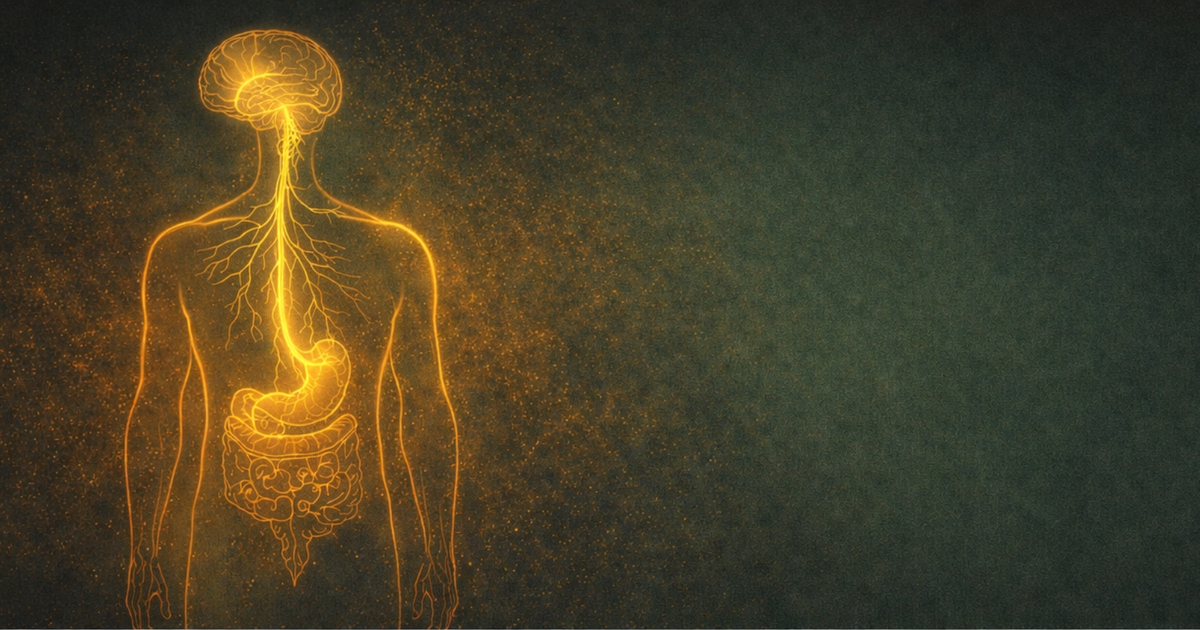
If there's one piece of your biology that determines more about your daily experience than almost anything else, it may be a nerve you've never thought about: the vagus nerve.*
Running from your brainstem through your neck, chest, and abdomen, the vagus nerve is the longest cranial nerve in your body. It's the primary communication highway between your brain and your organs. And according to Stephen Porges' research on the autonomic nervous system, it plays a central role in determining whether you feel safe enough to learn, connect, and change.*
What Vagal Tone Means for Your Habits
"Vagal tone" is a measure of how efficiently your vagus nerve functions — essentially, how quickly your body can shift from a stress response back to a calm, regulated state.* Research suggests that higher vagal tone is associated with better emotional regulation, improved focus, reduced anxiety, and — crucially for our purposes — greater capacity for behavioral flexibility.*
In practical terms: when your vagal tone is high, you're more adaptable. You recover from stress faster. New behaviors feel less effortful. When vagal tone is low, you get stuck in reactive patterns — the exact opposite of what habit formation requires.*
Vagal tone isn't something you either have or don't. It's trainable. And training it may be one of the most effective things you can do to support lasting behavior change.
The Autonomic Nervous System Hierarchy
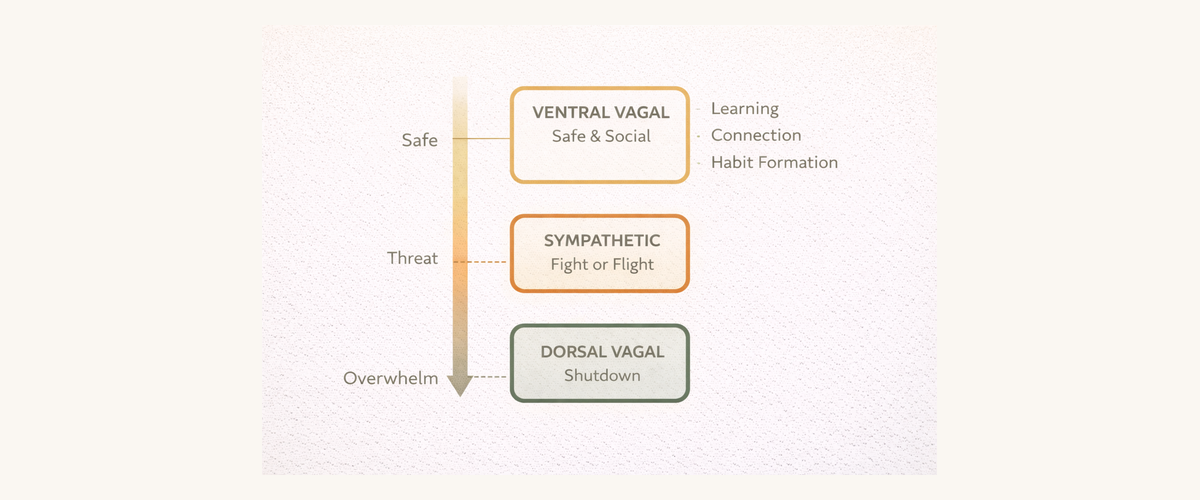
Porges' research proposes that your nervous system operates in a hierarchy of three states, each governed by different branches of the vagus nerve:*
Ventral vagal (safe and social). This is your optimal state for learning, connection, and change. Your heart rate is regulated, your breathing is deep, and your prefrontal cortex is fully online. This is where habit formation works best.*
Sympathetic (fight or flight). Activated when you perceive threat. Your body mobilizes energy for action, which means resources are pulled away from the "higher" functions like planning and impulse control.*
Dorsal vagal (shutdown). When threat is overwhelming, the system can collapse into conservation mode — numbness, dissociation, fatigue. This is the "I can't even start" feeling that many people mistake for laziness.*
Why This Matters for Building Habits
Most habit advice assumes you're starting from the ventral vagal state — calm, regulated, ready to take action. But many people attempting behavior change are operating from sympathetic or even dorsal vagal states without realizing it.*
If you've ever sat down to start a new routine and felt overwhelming resistance — not intellectual resistance, but a full-body "I can't do this" feeling — that may be your nervous system state, not your motivation level.*
This is why regulating your nervous system before attempting behavior change is so critical. You're not just "calming down." You're shifting into the biological state where new pattern formation is actually possible.*
Practical Ways to Strengthen Your Vagus Nerve
Research has identified several approaches that may support vagal tone.* These aren't complicated or time-consuming — but they need to be consistent:
Controlled breathing patterns. Extended exhales activate the parasympathetic branch of your nervous system. The 4-7-8 pattern (inhale 4 counts, hold 7, exhale 8) is a well-known protocol that may stimulate vagal activity.*
Cold exposure. Brief cold water exposure on the face or neck can trigger a vagal response called the "dive reflex," which may rapidly shift nervous system state.*
Humming and vocalization. The vagus nerve passes through the vocal cords. Humming, chanting, or even gargling can create mechanical stimulation that may strengthen the vagus nerve over time.*
Social connection. The ventral vagal system evolved for social engagement. Genuine face-to-face connection — where you feel safe and seen — is one of the most powerful vagal regulators we have.*
This is why The Calm Start Kit begins with nervous system calming protocols. Not because it's a trendy wellness concept, but because the research suggests your nervous system state is the foundation everything else is built on.*
Start calming your nervous system today. The free Calm Start Kit includes 7 body-first practices — or get The Calm Sleep Reset for the complete routine built on behavioral sleep science principles.
Start Calming Your Nervous System Today
The Calm Start Kit includes 7 free nervous system regulation exercises — simple protocols to help your body shift from stress to calm. Or get the full 7-day sleep protocol.
Sources & Further Reading
- Porges, S. W. (2011). The Polyvagal Theory: Neurophysiological Foundations of Emotions, Attachment, Communication, and Self-Regulation. W.W. Norton.
- Breit, S., Kupferberg, A., Rogler, G., & Hasler, G. (2018). Vagus nerve as modulator of the brain–gut axis in psychiatric and inflammatory disorders. Frontiers in Psychiatry, 9, 44.
- Gerritsen, R. J. S. & Band, G. P. H. (2018). Breath of life: The respiratory vagal stimulation model of contemplative activity. Frontiers in Human Neuroscience, 12, 397.
*Educational content only. Not medical, psychological, or therapeutic advice. References to autonomic nervous system research are for educational purposes. Consult healthcare professionals before making health changes. Individual results vary.