
You've been consistent for three weeks. The new habit is starting to feel natural. Then a stressful week hits — a work deadline, a family issue, a sleepless night — and suddenly you're back to old patterns like the new habit never existed.
Sound familiar? This isn't a willpower failure. It's a predictable neurological response, and understanding it changes how you approach habit formation entirely.
What Stress Does to Your Brain's Habit Systems
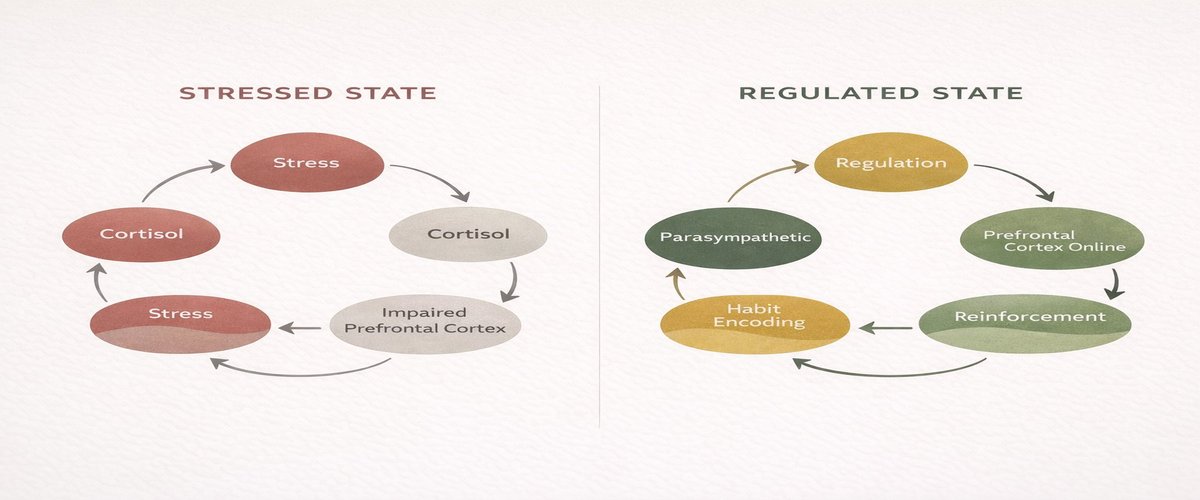
Under acute stress, your brain undergoes a shift in which neural systems take priority. Research has shown that stress hormones — particularly cortisol at chronically elevated levels — may impair prefrontal cortex function while simultaneously strengthening activity in the dorsal striatum, the brain region associated with habitual (but often older) behavior patterns.*
In practical terms: stress doesn't just make it harder to do new habits. It may actively redirect your behavior toward older, more established patterns — even ones you thought you'd moved past.* Your brain is essentially reverting to what it already knows under conditions where cognitive resources are scarce.*
Stress doesn't reveal a lack of discipline. It reveals which neural pathways are most deeply encoded — and new habits simply haven't had enough time to compete with old ones.
The Sympathetic Trap
When your sympathetic nervous system is chronically activated — which is increasingly common in modern life — your brain prioritizes survival-oriented behaviors over growth-oriented ones.* Building new habits is fundamentally a growth activity. It requires the prefrontal cortex to be fully functional, working memory to hold new patterns, and the parasympathetic system to be engaged enough for encoding.*
Chronic sympathetic activation may undermine all three of these requirements simultaneously.* This is why someone can be incredibly disciplined under calm conditions but lose that consistency the moment life gets hard. The issue isn't character — it's nervous system state.
Build habits that hold up under stress. The free Calm Start Kit gives you 3 nervous system tools for your worst days — or get The Calm Sleep Reset for the complete sleep-support routine.
Why "Just Push Through" Backfires
The conventional advice — push through stress, maintain discipline regardless of how you feel — may actually be counterproductive based on what the research suggests.* Forcing behavior change while in a dysregulated state can create a stress association with the new habit itself. Your brain may begin categorizing the new behavior as a stressor rather than a reward, making it progressively harder to maintain.*
This might explain why so many people develop an aversion to habits they once enjoyed. The gym becomes dreaded. The morning routine feels like punishment. The meditation practice generates anxiety instead of calm. The behavior got linked to a stressed state during the encoding process.*
Building Stress-Resilient Habits
If stress vulnerability is the problem, the solution isn't more discipline — it's deeper encoding. Here's what the research suggests may help:
Regulate before you practice. Spending even 2-3 minutes in a nervous system regulation protocol before engaging in your new habit may change the neurochemical context in which the behavior is encoded. Calm encoding may produce more resilient neural pathways than stressed encoding.*
Build a "minimum viable habit." When stress hits, having a stripped-down version of your habit — one so simple it's almost impossible to skip — may help you maintain the neural pathway even when full practice isn't possible. Five minutes of movement instead of 45. One paragraph of journaling instead of a page. The pathway stays active.*
Practice during varied states. Research on "contextual interference" suggests that practicing a skill under slightly varied conditions may produce more flexible and resilient learning.* Occasionally practicing your habit when you're slightly tired, slightly stressed, or in a different environment may build more robust neural patterns.*
Prioritize recovery. Sleep, social connection, and dedicated downtime aren't luxuries that compete with habit building — they're the infrastructure that makes habit building possible. Chronic stress without adequate recovery may continuously reset the encoding process.*
The goal isn't to become stress-proof. It's to build habits that have been encoded deeply enough, and in enough varied conditions, that they survive the inevitable disruptions of real life.*
Stop Letting Stress Steal Your Progress
The Calm Sleep Reset is a 7-day protocol designed for real life — including your worst weeks. Built on behavioral sleep science, not willpower.
Sources & Further Reading
- Schwabe, L. & Wolf, O. T. (2009). Stress prompts habit behavior in humans. Journal of Neuroscience, 29(22), 7191–7198.
- Arnsten, A. F. T. (2009). Stress signalling pathways that impair prefrontal cortex structure and function. Nature Reviews Neuroscience, 10(6), 410–422.
- McEwen, B. S. (2007). Physiology and neurobiology of stress and adaptation: Central role of the brain. Physiological Reviews, 87(3), 873–904.
- Porges, S. W. (2011). The Polyvagal Theory. W.W. Norton.
*Educational content only. Not medical, psychological, or therapeutic advice. Consult healthcare professionals before making health changes. Individual results vary.