
Habit formation is almost always framed as a solo project — you against your brain, armed with discipline and a habit tracker. But neuroscience tells a different story. Humans are social nervous systems, and research increasingly suggests that the people around you may influence your habit formation more than any individual strategy.*
The Neuroscience of Co-Regulation
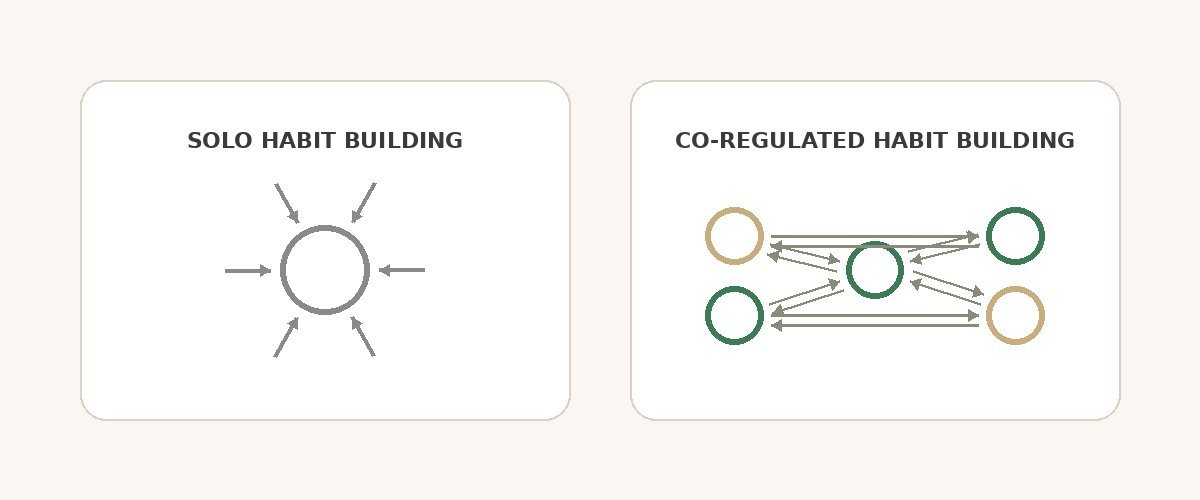
Co-regulation is a concept from Stephen Porges' research on the autonomic nervous system. It describes how connection can be one support for regulation: nervous systems may influence physiological state in each other based on the social cues of people around us.*
When you're near someone whose nervous system is calm and regulated, your own nervous system tends to mirror that state. This isn't metaphorical — it's measurable. Research on heart rate variability synchronization shows that people in close proximity begin to entrain their physiological rhythms.*
This matters for habits because, as we've discussed in previous articles, your nervous system state determines which behaviors are biologically available to you. A dysregulated nervous system defaults to survival behaviors. A regulated one can encode new patterns.*
Mirror Neurons and Behavioral Contagion
Your brain contains mirror neuron systems that activate when you observe someone else performing a behavior — firing in patterns similar to performing the behavior yourself. This isn't just imitation; it's neurological rehearsal.*
Research from Nicholas Christakis and James Fowler found that health behaviors spread through social networks in measurable ways. If a close friend develops a habit, your likelihood of developing that same habit may increase significantly — even if you never consciously decided to adopt it.*
Your nervous system doesn't just regulate itself. It's constantly being shaped by the nervous systems around it.
Start with your own nervous system first. The free Calm Start Kit gives you 3 tools to regulate your system tonight — then you become the calm presence others can co-regulate with.
Why Solo Habit-Building Is Playing on Hard Mode
When you try to build habits in isolation, you're fighting against your biology in two ways:*
No co-regulation support. Without regulated nervous systems around you, you have to generate all your own parasympathetic tone. That's possible — but it's harder. It's like trying to warm a room with no insulation.*
No mirror neuron rehearsal. Without seeing others perform the behaviors you're trying to adopt, your brain doesn't get the free neurological practice that comes from observation. You're building every neural pathway from scratch.*
Practical Co-Regulation Strategies
Find one regulated person. You don't need a community of hundreds. Research suggests that even one person with a calm, regulated nervous system can shift yours. Identify someone in your life who feels grounding — not motivating, grounding — and spend more time with them.*
Practice habits in shared spaces. Even without direct interaction, being in the physical presence of others who are focused and calm (a library, a quiet coffee shop, a yoga class) provides passive co-regulation benefits.*
Be selective about digital nervous systems. Your mirror neurons respond to digital content too. Scrolling through anxious, reactive social media feeds activates your sympathetic nervous system. Curate your inputs toward calm, focused content — especially in the first and last hours of your day.*
Create accountability through connection, not pressure. Traditional accountability is often based on shame — "I'll feel bad if I tell them I didn't do it." More effective: share your practice with someone who is also building habits. The co-regulation of shared experience strengthens both of your nervous systems.*
Regulate yourself first. Co-regulation works both ways. As you develop your own regulatory capacity through breathing protocols, sleep optimization, and morning routines, you become a co-regulating presence for others. This creates a positive feedback loop.*
Regulate Yourself First — Then Watch the Ripple Effect
Co-regulation starts with your own nervous system. The Calm Sleep Reset gives you a complete 7-day protocol built on behavioral sleep science to get your body out of survival mode.
Sources & Further Reading
- Porges, S. W. (2011). The Polyvagal Theory: Neurophysiological Foundations of Emotions, Attachment, Communication, and Self-Regulation. W.W. Norton.
- Christakis, N. A. & Fowler, J. H. (2007). The spread of obesity in a large social network over 32 years. New England Journal of Medicine, 357(4), 370–379.
- Feldman, R. (2012). Bio-behavioral synchrony: A model for integrating biological and microsocial behavioral processes. Neuroscience & Biobehavioral Reviews, 36(3), 1369–1378.
- Kok, B. E. & Fredrickson, B. L. (2010). Upward spirals of the heart: Autonomic flexibility as indexed by vagal tone. Biological Psychology, 85(3), 432–436.
*Educational content only. Not medical, psychological, or therapeutic advice. References to neuroscience research are for educational context. Consult healthcare professionals before making health changes. Individual results vary.