
You've probably heard "just take a deep breath" a thousand times. And a thousand times, it probably didn't work. That's not because breathing exercises are useless — it's because most people are doing the wrong protocol for the wrong state.
Here's what nobody tells you: not all breathing patterns do the same thing to your nervous system. Some activate your sympathetic branch (fight-or-flight), some activate your parasympathetic branch (rest-and-digest), and some toggle between both. If you're already in a heightened state and you take a big inhale-dominant breath, you're pouring gasoline on the fire.
The difference between a breathing exercise that calms you and one that makes anxiety worse comes down to one thing: the ratio of your inhale to your exhale.
Why Breathing Is the Fastest Nervous System Lever
Your autonomic nervous system runs most of your body without your conscious input — heart rate, digestion, pupil dilation, blood pressure. You can't will your heart rate down. You can't decide to digest faster. But you can control your breathing, and breathing is the one autonomic function that has a manual override.*
The vagus nerve — the primary communication highway between your brain and your body — is directly stimulated by the mechanical act of slow, extended exhalation. When you breathe out longer than you breathe in, the diaphragm pushes up, the heart physically compresses slightly, and stretch receptors around the heart send a signal through the vagus nerve to the brainstem: slow down.*
Neuroscientist Andrew Huberman at Stanford has published extensively on this mechanism. The key finding: you don't need 20 minutes of meditation to shift your nervous system state. With the right protocol, the shift can happen in one to three breath cycles.*
The Three Practices That Tend to Help Most
Not every situation calls for the same breathing pattern. Here are three protocols backed by research, each designed for a different nervous system state.*
Protocol 1: The Physiological Sigh (Acute Stress Reset)
When to use it: You're in a moment of acute stress — racing heart, tight chest, spinning thoughts. You need to calm down right now.
How: Take a deep inhale through the nose, then at the top of that inhale, sneak in a second short inhale (a "double inhale") to fully inflate the lungs. Then let out a long, slow exhale through the mouth — make the exhale at least twice as long as the inhale.
Why it works: The double inhale maximally inflates the tiny air sacs (alveoli) in the lungs. When they're fully open, they have maximum surface area to offload carbon dioxide during the exhale. The extended exhale then activates your body's calming response. Some people may feel a noticeable shift within a few breath cycles.*
Protocol 2: 4-7-8 Breathing (Pre-Sleep & Chronic Tension)
When to use it: You're lying in bed with a racing mind, or you carry chronic low-grade tension throughout your day. Not acute panic — more like your baseline is set too high.
How: Inhale through the nose for 4 counts. Hold for 7 counts. Exhale slowly through the mouth for 8 counts. Repeat for 4 cycles.
Why it works: The hold phase allows CO₂ to build slightly, which paradoxically triggers a relaxation response when you finally release the exhale. The 8-count exhale — double the inhale — is the key. It sends sustained vagal activation signals. Over 4 cycles (roughly 75 seconds), you systematically downshift your entire autonomic state.*
Protocol 3: Box Breathing (Sustained Focus & Regulation)
When to use it: You need to stay calm and alert — before a meeting, during a difficult conversation, or as a daily regulation practice. This is the protocol used by Navy SEALs, and for good reason.
How: Inhale for 4 counts. Hold for 4 counts. Exhale for 4 counts. Hold for 4 counts. Repeat for 4–6 cycles.
Why it works: The equal ratios (4-4-4-4) create balance between sympathetic and parasympathetic activation. You're not trying to crash into relaxation — you're building a regulated, resilient baseline. The holds train your nervous system to tolerate the pause between states, which builds what Stephen Porges calls "vagal flexibility."*
The Mistake Most People Make
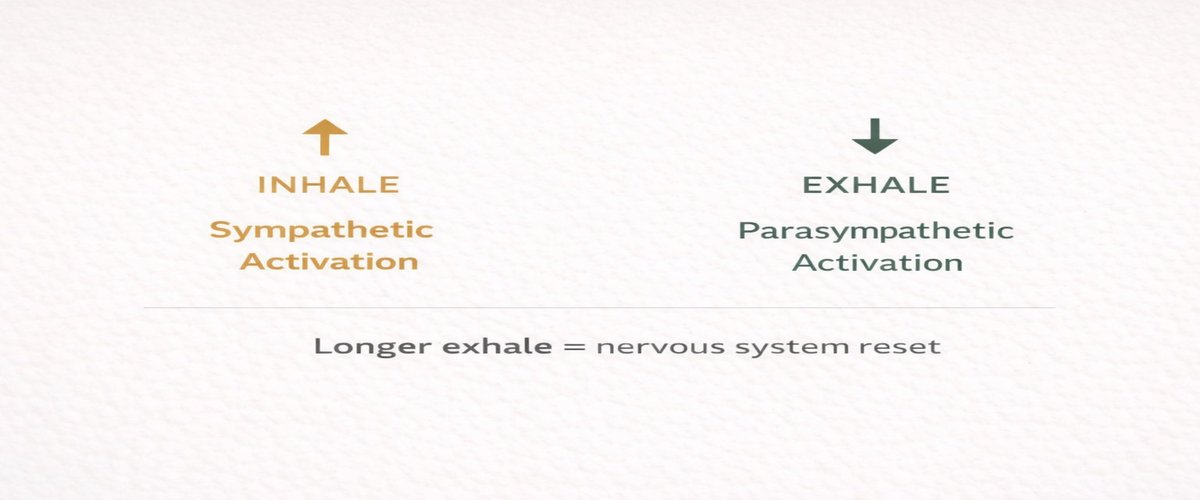
Here's where people go wrong: they try to "breathe deeply" by taking huge inhales. Big inhales activate your sympathetic nervous system. That's the accelerator, not the brake. If you're anxious and you gulp in a massive breath, you're telling your body to go faster.*
The power is in the exhale. Always.
If you remember nothing else from this article, remember this: when you want to calm down, make your exhale longer than your inhale. That single shift may support a calmer physiological state, and the prefrontal cortex (the rational, decision-making part of the brain) tends to come back online.*
When your exhale exceeds your inhale, the diaphragm compresses the heart on its upward movement, activating stretch receptors in the cardiac tissue. These fire through vagal afferent fibers to the brainstem, which then inhibits sympathetic output. Your body gets a direct "stand down" signal — no willpower required.
Building a Daily Breathing Practice (Under 5 Minutes)
You don't need an hour on a meditation cushion. Research suggests that consistent short practices outperform occasional long ones for nervous system regulation.*
A practical daily protocol: two minutes of box breathing in the morning (to set a regulated baseline) and one physiological sigh whenever stress spikes during the day. At bedtime, four cycles of 4-7-8 breathing before sleep. Total daily investment: under five minutes. The neurological payoff compounds over weeks as your nervous system adapts — meaning your baseline shifts so you're less reactive to stress in the first place.*
Want all three practices in a printable guide? The free Calm Start Kit includes guided breathing sequences you can use tonight — or get The Calm Sleep Reset for the complete sleep-support routine.
This is biology, not belief. Your nervous system doesn't care about your mindset, your affirmations, or your motivation level. It responds to mechanical, physiological inputs — and breathing is the one you can control right now, in real time, every single day.
What Happens When You Stay Consistent
The real transformation isn't the in-the-moment calm (though that matters). It's what happens over time. Consistent practice of breathing practices may support stress recovery over time. Some people notice a calmer baseline emotional state and may support markers associated with stress regulation.*
HRV is one commonly used marker of autonomic regulation. Some people see changes in HRV measurements with consistent daily practice over a few weeks of consistent practice.*
That's the promise of working with your biology instead of against it. You're not trying to think your way calm. You're building a nervous system that defaults to calm — and the breath is the fastest lever you have.
Body-First Tools for a Calmer Nervous System
The Calm Start Kit includes 7 free body-first tools that support nervous system regulation, including guided breathing sequences and stress release techniques. Or get the full sleep-support routine.
Sources & Further Reading
- Balban, M. Y. et al. (2023). Brief structured respiration practices enhance mood and reduce physiological arousal. Cell Reports Medicine, 4(1), 100895.
- Zaccaro, A. et al. (2018). How breath-control can change your life: A systematic review. Frontiers in Human Neuroscience, 12, 353.
- Porges, S. W. (2011). The Polyvagal Theory. W.W. Norton.
- Ma, X. et al. (2017). The effect of diaphragmatic breathing on attention, negative affect and stress. Frontiers in Psychology, 8, 874.
*Educational content only. Not medical, psychological, or therapeutic advice. Routines shared for informational purposes. Consult healthcare professionals before making health changes. Individual results vary. References to research are for educational context; Better Life Habits does not claim clinical validation of its specific protocols.