
Most people think about habit formation as something that happens during waking hours — the moment you do the behavior. But neuroscience research suggests that the real consolidation — the actual strengthening of new patterns — may happen while you're asleep.*
If you're building new habits while chronically under-sleeping, you may be undermining the very process that makes those habits stick.
What Happens to Your Brain During Sleep
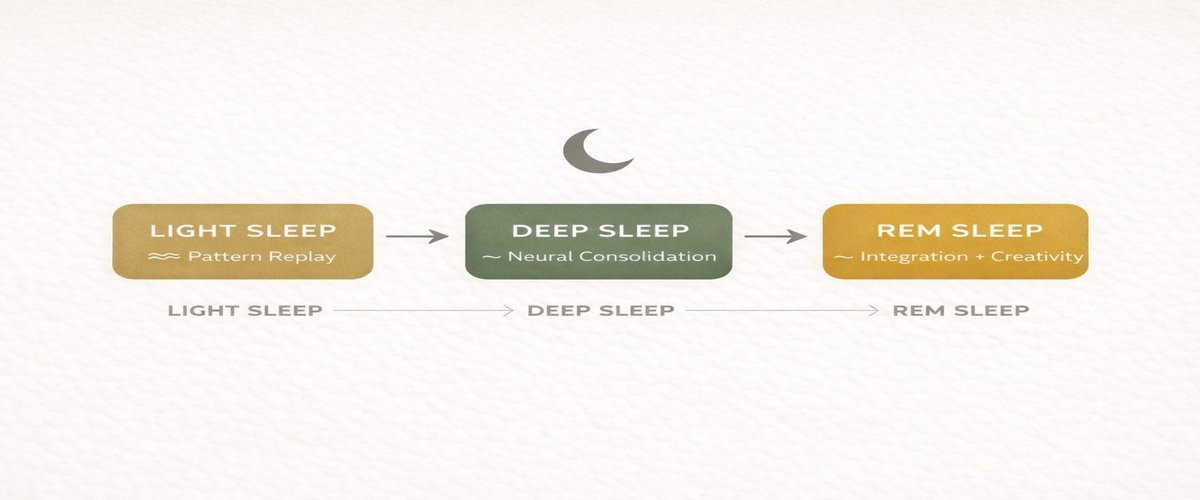
Sleep isn't a passive state. Your brain cycles through distinct phases — light sleep, deep sleep (slow-wave sleep), and REM sleep — each serving different functions.* Two of these phases appear to be particularly relevant for habit formation:
Deep sleep (slow-wave sleep) is when your brain may consolidate declarative memories and procedural skills. During this phase, neural patterns activated during the day are "replayed" at accelerated speeds, potentially strengthening the synaptic connections that encode new behaviors.* Researchers have observed this replay phenomenon in studies of motor learning and spatial navigation.*
REM sleep may be where your brain integrates new learning with existing knowledge, forms creative connections, and processes emotional associations with new behaviors.* This integration process could be what transforms a behavior from "something I'm consciously doing" to "something that feels like part of who I am."*
You don't just practice habits during the day. You may consolidate them at night. Sleep isn't competing with your productivity — it may be completing the neural work your daytime practice started.
Sleep isn't wasted time — it's when habits lock in. The Calm Sleep Reset is a complete 7-day protocol built on behavioral sleep science to help you build a calmer sleep pattern. Or start free with the Calm Start Kit.
Sleep Deprivation and Habit Failure
Research on sleep deprivation paints a concerning picture for anyone trying to build new habits. Even moderate sleep restriction may impair prefrontal cortex function by 20-30%, reduce emotional regulation capacity, increase default reliance on established (old) habits rather than newly learned behaviors, and diminish the brain's ability to consolidate new learning during subsequent sleep.*
This creates a vicious cycle: poor sleep may impair the brain function needed for conscious habit practice during the day, while simultaneously reducing the quality of nighttime consolidation. You're fighting the battle on two fronts — with fewer resources.*
The Glymphatic System: Your Brain's Cleaning Crew
During deep sleep, your brain's glymphatic system — a waste clearance mechanism that operates primarily during sleep — may remove metabolic byproducts that accumulate during waking hours, including beta-amyloid and other proteins associated with cognitive impairment.* This "cleaning" process may be essential for maintaining the neural environment where new connections can form effectively.*
Chronic sleep deprivation may allow these waste products to accumulate, potentially creating a less favorable environment for the synaptic changes that underlie habit formation.*
Practical Sleep Protocols for Habit Building
Based on current sleep research, here are evidence-informed strategies that may support the consolidation process:
Protect your sleep architecture. It's not just total hours — it's the completeness of your sleep cycles. Alcohol, late caffeine, and blue light exposure close to bedtime may all disrupt sleep architecture even if you "feel" like you slept enough.* The consolidation phases you need for habit encoding may be particularly vulnerable to these disruptions.*
Practice your target habit earlier in the day. Research suggests that behaviors practiced earlier in the waking period may benefit from more complete consolidation, as the brain has a full night of sleep cycles to process them.* Evening practice isn't useless, but the consolidation window may be compressed.*
Use an evening wind-down protocol. Transitioning from sympathetic activation to parasympathetic states before sleep may improve both sleep onset and sleep quality. This isn't just about relaxation — it's about creating the nervous system conditions that support optimal sleep architecture.*
Maintain consistent timing. Your circadian system thrives on regularity. Consistent sleep and wake times may support more reliable cycles of the deep sleep and REM phases where consolidation occurs.*
Sleep is the silent partner in every habit you build. Optimizing it doesn't require expensive supplements or tracking devices — just an understanding that the work you do during the day needs nighttime processing to become permanent.*
Protect Your Sleep. Lock In Your Habits.
The Calm Sleep Reset is a 7-day educational sleep-support routine, built around common behavioral sleep principles. Practice a calmer nighttime response.
Sources & Further Reading
- Walker, M. (2017). Why We Sleep: Unlocking the Power of Sleep and Dreams. Scribner.
- Stickgold, R. (2005). Sleep-dependent memory consolidation. Nature, 437(7063), 1272–1278.
- Xie, L. et al. (2013). Sleep drives metabolite clearance from the adult brain. Science, 342(6156), 373–377.
- Diekelmann, S. & Born, J. (2010). The memory function of sleep. Nature Reviews Neuroscience, 11(2), 114–126.
*Educational content only. Not medical, psychological, or therapeutic advice. Consult healthcare professionals before making health changes. Individual results vary.