
You've seen the claim everywhere: "It takes 21 days to form a habit." It's on motivational posters, in self-help books, and all over social media. There's just one problem — it's not what the research says.*
Understanding how long habits actually take — and why the timeline varies so dramatically — can save you from quitting right when your brain is about to lock in a new pattern.
Where the 21-Day Myth Came From
The number traces back to Dr. Maxwell Maltz, a plastic surgeon who observed in 1960 that patients seemed to take about 21 days to adjust to changes in their appearance. He wrote that it takes "a minimum of about 21 days" for an old mental image to dissolve — and the self-help world dropped the word "minimum" and ran with the rest.*
It was never a study about habits. It was a surgeon's casual observation about body image adaptation. Somehow it became the most quoted "fact" in habit formation.*
What the Research Actually Shows
The most rigorous study on habit formation timelines comes from Phillippa Lally and colleagues at University College London (2009). They tracked 96 participants trying to form new habits and measured how long it took for behaviors to become automatic.*
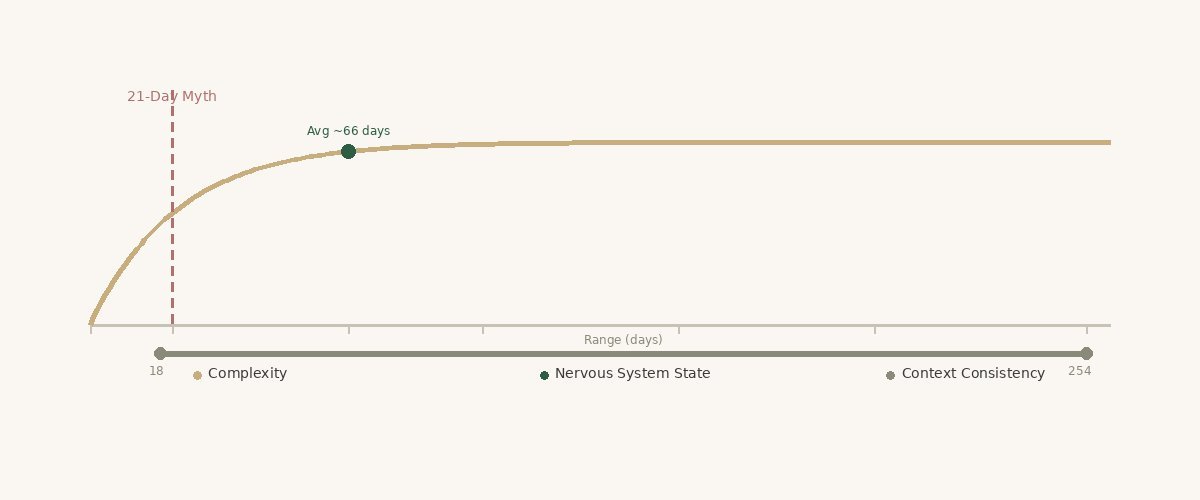
The average was 66 days. But the range was enormous — from 18 to 254 days. Some simple habits (drinking a glass of water with lunch) formed quickly. Complex behaviors (running for 15 minutes before dinner) took months.*
The timeline for habit formation isn't fixed — it's determined by complexity, consistency, and your nervous system state.
Why the Timeline Varies So Much
Behavioral complexity. Simple, low-friction behaviors form faster than complex, multi-step ones. Drinking water after brushing your teeth is neurologically simpler than a 20-minute morning meditation practice.*
Nervous system state. This is the factor most habit advice ignores entirely. Research suggests that chronic stress, sleep deprivation, and sympathetic nervous system dominance may significantly slow the neural consolidation that makes behaviors automatic. Your nervous system state may matter more than your consistency.*
Consistency of context. Habits that happen at the same time, same place, with the same preceding cue appear to form faster. Variable contexts force your brain to re-process the decision each time rather than automating it.*
The Real Metric: Automaticity, Not Days
Counting days is the wrong metric entirely. What you're actually building toward is automaticity — the point where the behavior requires minimal conscious effort or decision-making.*
Lally's research measured this using a "Self-Report Habit Index" that assessed how automatic behaviors felt. The key finding: automaticity follows an asymptotic curve. Progress is rapid at first, then gradually plateaus as the habit approaches its maximum strength.*
This means the difference between day 40 and day 80 may be much smaller than the difference between day 5 and day 20. You're getting the most neurological "return on investment" in those early weeks.*
What This Means Practically
Stop counting to 21. If your habit doesn't feel automatic at three weeks, that's normal — not failure. You're probably right in the middle of the formation curve.*
Prioritize your nervous system. Instead of white-knuckling through 66 days, focus on the conditions that speed up automaticity: sleep quality, stress regulation, and parasympathetic tone. A calm nervous system may encode habits faster than a stressed one pushing through on discipline.*
Start simpler than you think. If you want a complex habit, break it into the simplest possible version first. Let the automatic foundation build, then layer complexity on top.*
Missing a day isn't fatal. Lally's research also found that missing a single day did not significantly derail the habit formation process. The "don't break the chain" advice creates unnecessary anxiety that may actually slow you down by activating your stress response.*
Ready to work with your biology instead of against it? The free Calm Start Kit gives you 3 body-first nervous system support tools you can use tonight — or grab The Calm Sleep Reset for the complete 7-day sleep-support routine.
Stop Counting Days. Start Regulating Your System.
Real habit change follows biology, not calendars. The Calm Sleep Reset is a 7-day protocol built on behavioral sleep science — the same evidence base recommended by the American College of Physicians.
Sources & Further Reading
- Lally, P., van Jaarsveld, C. H. M., Potts, H. W. W., & Wardle, J. (2010). How are habits formed: Modelling habit formation in the real world. European Journal of Social Psychology, 40(6), 998–1009.
- Maltz, M. (1960). Psycho-Cybernetics. Prentice Hall.
- Gardner, B., Lally, P., & Wardle, J. (2012). Making health habitual: The psychology of "habit-formation" and general practice. British Journal of General Practice, 62(605), 664–666.
- Wood, W. & Neal, D. T. (2007). A new look at habits and the habit-goal interface. Psychological Review, 114(4), 843–863.
*Educational content only. Not medical, psychological, or therapeutic advice. References to neuroscience research are for educational context. Consult healthcare professionals before making health changes. Individual results vary.