
Morning routines get a lot of attention in the personal development space — but most advice focuses on productivity hacks rather than what's actually happening in your brain during those first hours. The neuroscience tells a more interesting and more useful story.
Your first 90 minutes after waking represent a distinct neurochemical environment. Understanding what's happening biologically during this window can help you structure morning habits that work with your brain instead of against it.*
The Cortisol Awakening Response
Within 30-45 minutes of waking, your body experiences what researchers call the Cortisol Awakening Response (CAR) — a natural surge of cortisol that peaks about 30 minutes after your eyes open.* This isn't the "stress cortisol" you hear about in wellness circles. This is your body's biological alarm system doing exactly what it's supposed to do.
This cortisol pulse serves critical functions: it increases alertness and attention, promotes immune function, helps clear adenosine (the neurochemical that builds sleep pressure), and primes the brain for learning and memory formation.* The timing of this response may create a natural window where your brain is especially receptive to new pattern formation.*
Build a morning routine that works with your biology. The free Calm Start Kit includes morning practices that work with your cortisol rhythm — or get The Calm Sleep Reset for the complete circadian routine.
The cortisol awakening response isn't your enemy. It's a neurochemical opportunity — a biological signal that your brain is ready to encode new information and behaviors.
Light Exposure and Your Circadian Clock
Research from Andrew Huberman and others has emphasized that early morning light exposure — specifically within the first hour of waking — may be one of the most powerful signals for your circadian system.* Photons hitting specific cells in your retina (intrinsically photosensitive retinal ganglion cells) send timing signals to your suprachiasmatic nucleus, the brain's master clock.*
This isn't just about feeling more awake. Circadian rhythm disruption has been linked to impaired prefrontal cortex function — the very brain region you need for conscious habit building.* Proper circadian alignment may support better executive function, improved emotional regulation, and enhanced capacity for behavioral change.*
Adenosine Clearance and the Focus Window
Throughout the day, a neurochemical called adenosine accumulates in your brain, creating progressively stronger sleep pressure. During sleep, your glymphatic system clears much of this adenosine.* The first 90-120 minutes after waking represent a period of relatively low adenosine — a window of natural alertness before the accumulation process rebuilds momentum.*
This low-adenosine period may coincide with enhanced capacity for focused attention — exactly the kind of attention that research suggests drives neuroplastic change.* It's worth noting that caffeine works by blocking adenosine receptors, which is why many researchers suggest delaying caffeine intake for 60-90 minutes after waking to avoid disrupting your natural cortisol and adenosine patterns.*
Structuring Your Morning for Your Biology
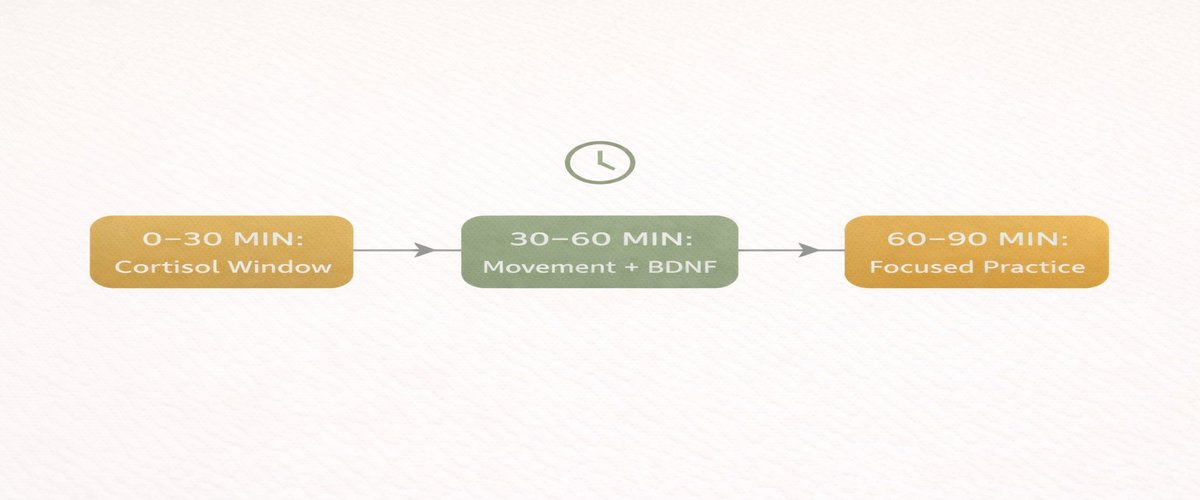
Based on this research, here's what a neuroscience-informed morning might look like:
Minutes 0-10: Regulate first. Before reaching for your phone or making decisions, use a brief nervous system regulation protocol — deep breathing, gentle movement, or grounding exercises. This shifts your nervous system from the sleep-to-wake transition into a regulated parasympathetic baseline.*
Minutes 10-30: Get light exposure. Step outside or position yourself near a bright window. Even 10 minutes of natural light exposure may help synchronize your circadian clock and support the cortisol awakening response.*
Minutes 30-90: Practice your target habit. This is your neurochemical sweet spot — elevated cortisol promoting alertness, low adenosine supporting focus, and a regulated nervous system providing the foundation for new pattern encoding. Use this window for whatever habit you're building.*
The key insight isn't that mornings are "better" in some motivational sense. It's that your neurochemistry during this period may create conditions that are specifically favorable for the kind of focused, regulated practice that drives lasting habit formation.*
Start the Morning Right. Support Your Nervous System.
The Calm Start Kit gives you 7 free morning protocols designed around your biology — circadian timing, nervous system regulation, and simple daily systems.
Sources & Further Reading
- Walker, M. (2017). Why We Sleep: Unlocking the Power of Sleep and Dreams. Scribner.
- Huberman, A. (2021). Optimizing your morning routine. Huberman Lab Podcast, Episode 28.
- Loprinzi, P. D. & Kane, C. J. (2015). Exercise and cognitive function: A randomized controlled trial. Brain Research, 1622, 390–395.
- Figueiro, M. G. et al. (2017). The impact of daytime light exposures on sleep and mood in office workers. Sleep Health, 3(3), 204–215.
*Educational content only. Not medical, psychological, or therapeutic advice. Consult healthcare professionals before making health changes. Individual results vary.