
Most habit advice focuses on what happens inside your head — motivation, discipline, mindset. But neuroscience research increasingly suggests that your physical environment may have more influence over your behavior than your intentions do.*
Your surroundings aren't just the backdrop to your habits. They're the cue system that triggers them.
Your Brain Is an Efficiency Machine
Your prefrontal cortex — the part responsible for conscious decision-making — consumes enormous amounts of energy. Research suggests your brain actively looks for ways to offload decisions to automatic systems whenever possible.*
This is what habits are: behaviors your brain has automated so your prefrontal cortex doesn't have to stay involved. And the primary trigger for these automated behaviors isn't willpower or motivation — it's environmental cues.*
Every object in your environment, every spatial arrangement, every sensory input is either cueing a behavior or not. Most of us have never deliberately designed these cues — we've inherited them by accident.*
Context-Dependent Memory and Behavior
Research on context-dependent memory demonstrates that your brain encodes behaviors along with the environment in which they occur. This is why you might crave popcorn at a movie theater even when you're not hungry, or feel sleepy in your living room but alert in a coffee shop.*
Wendy Wood's research at USC found that approximately 43% of daily behaviors are performed in the same location almost every time. Your brain isn't deciding to do these things — the environment is triggering them automatically.*
Your environment makes most of your decisions before willpower ever gets a vote.
Design your sleep environment for calm. The free Calm Start Kit includes the Phone Sleep Home setup guide, or get The Calm Sleep Reset for a complete environment and routine overhaul.
The Two Laws of Environment Design
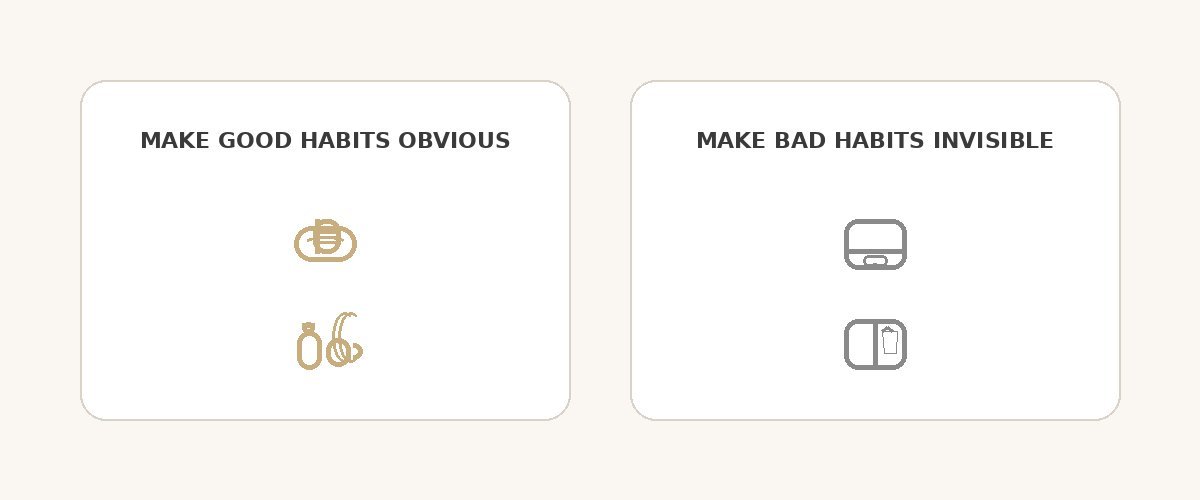
Law 1: Make good behaviors obvious. If you want to build a new habit, make the cue impossible to miss. Place your journal on your pillow. Put your supplements next to your coffee maker. Set your workout clothes on the bathroom counter the night before. The less searching or deciding required, the more likely the behavior happens.*
Law 2: Make unwanted behaviors invisible. Remove or hide the cues for behaviors you're trying to change. Phone in another room during focus time. Junk food behind closed cabinet doors — or out of the house entirely. Unsubscribe from email lists that trigger impulse purchases.*
Environment and Your Nervous System
Here's what most environment design advice misses: your physical space doesn't just cue specific behaviors — it shapes your nervous system state.*
Cluttered environments have been associated with elevated cortisol in research from UCLA's Center on Everyday Lives and Families. Visual noise may keep your sympathetic nervous system activated — the same stress response that impairs habit formation.*
Conversely, organized, calm spaces may support parasympathetic tone — the nervous system state where new habit encoding happens most efficiently. This means that tidying your environment isn't just about aesthetics — it's about creating the neurological conditions for behavior change.*
Practical Environment Protocols
Audit your morning path. Walk through the first 30 minutes of your morning and notice every decision point. Each decision is a place where willpower can fail. Pre-decide and pre-place everything the night before.*
Create single-purpose zones. Your brain forms stronger cue-behavior associations when spaces have consistent uses. If your couch is for Netflix and also for reading, neither habit forms strong cues. Designate a specific chair for reading.*
Design a "reset station." A designated spot where you prepare tomorrow's environment tonight — lay out clothes, prep the coffee, set out supplements, place your journal. This 5-minute evening ritual removes dozens of morning decisions.*
Reduce visual noise. Clear surfaces in your primary living and working spaces. Not for minimalism's sake — for your nervous system's sake. Fewer visual inputs means less background sympathetic activation.*
Redesign Your Environment. Rebuild Your Habits.
The Calm Sleep Reset includes environment design protocols for sleep, stress, and energy — built on behavioral sleep science, not willpower.
Sources & Further Reading
- Wood, W., Quinn, J. M., & Kashy, D. A. (2002). Habits in everyday life: Thought, emotion, and action. Journal of Personality and Social Psychology, 83(6), 1281–1297.
- Saxbe, D. E. & Repetti, R. (2010). No place like home: Home tours correlate with daily patterns of mood and cortisol. Personality and Social Psychology Bulletin, 36(1), 71–81.
- Thaler, R. H. & Sunstein, C. R. (2008). Nudge: Improving Decisions About Health, Wealth, and Happiness. Yale University Press.
- Neal, D. T., Wood, W., & Quinn, J. M. (2006). Habits — a repeat performance. Current Directions in Psychological Science, 15(4), 198–202.
*Educational content only. Not medical, psychological, or therapeutic advice. References to neuroscience research are for educational context. Consult healthcare professionals before making health changes. Individual results vary.