
You wake up already tired. You drink coffee and feel jittery. Your energy crashes by 2PM. You're wired at night. You blame age, stress, or not sleeping enough.
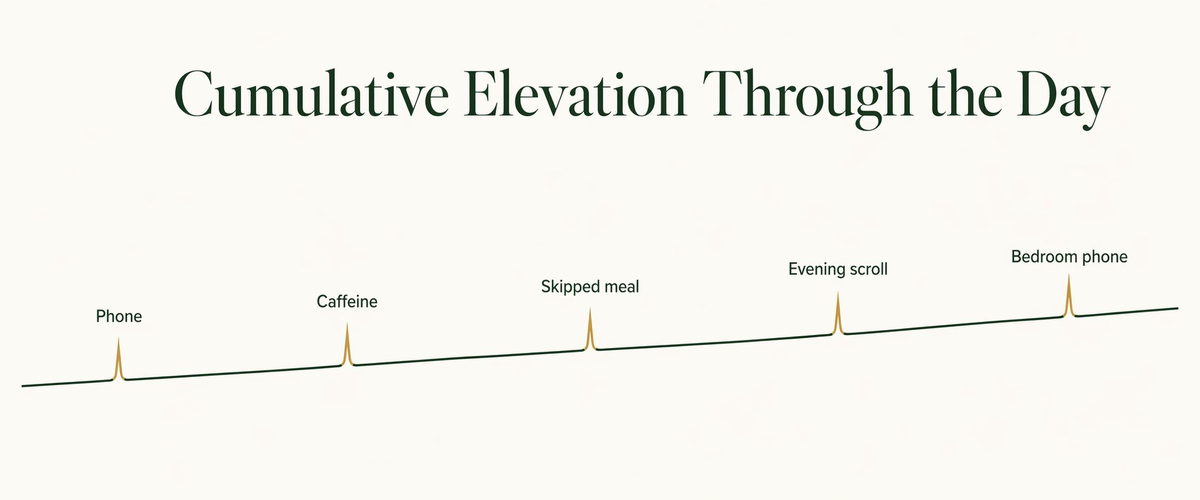
In most cases, the real driver is cortisol, and the biggest cortisol spikes of your day are coming from habits so ordinary you'd never suspect them. Five in particular show up repeatedly in research on stress physiology and circadian rhythm.*
Why Cortisol Matters More Than People Realize
Cortisol isn't the villain. You need it. It's the hormone that wakes you up, gives you energy, sharpens attention, and mobilizes glucose when you need it. The problem isn't cortisol itself. It's cortisol firing at the wrong times, in the wrong amounts, and not coming down when it should.*
Chronically elevated cortisol is linked to disrupted sleep, impaired immune function, belly fat accumulation, flattened mood, and cognitive fog. The five habits below are not catastrophic individually. Stacked across every day for years, they keep the system running hot.*
Habit 1: Phone Before Sunlight
Opening your phone before you've seen outdoor light is one of the most consistent cortisol spikers available. Two things happen at once: the screen delivers artificial blue light that suppresses the natural morning cortisol curve, and the content — notifications, email, news — delivers a threat-assessment load before your nervous system has had a chance to come online.*
The reset: No phone for the first 10 minutes after waking. Walk outside instead, even just on a porch or balcony. Direct outdoor light in the first hour sets your circadian clock and anchors the cortisol curve where it belongs.*
Habit 2: Caffeine Before Food
Drinking coffee on an empty stomach hits an already-elevated cortisol system with another spike. Your cortisol peaks about 30 to 45 minutes after waking (the Cortisol Awakening Response) — adding caffeine into that window compounds the stress signal rather than replacing the natural rise.*
The reset: Wait 60 to 90 minutes after waking before your first coffee. Eat something with protein first. The combination flattens the cortisol-on-cortisol spike and prevents the mid-afternoon crash that almost always follows it.*
Habit 3: Skipping Meals or Eating Too Late
When you skip meals, blood sugar drops, and cortisol fires to release stored glucose. It's doing its job. But if you regularly go long stretches without eating, or you push dinner past 8PM, you train the system to fire cortisol at times when it should be quiet.*
Late eating is especially disruptive because it triggers cortisol and insulin responses right when the body is trying to transition into parasympathetic dominance for sleep. The digestive load and the hormone response combined fight the wind-down.*
The reset: Eat within 90 minutes of waking. Finish dinner at least 2 to 3 hours before bed. Predictable meal timing is one of the strongest signals to stabilize the cortisol curve.*
Habit 4: Scrolling Right Before Bed
The pre-bed scroll is a two-sided cortisol trigger. First, the blue light from screens suppresses melatonin, which delays the sleep-onset cortisol drop. Second, the content itself — news, social media, work email — delivers a stream of small activations right when the system should be winding down.*
Research on screen use before bed shows measurable delays in sleep onset and reductions in REM sleep, both of which further disrupt the cortisol curve for the next day.*
The reset: Put the phone away 60 minutes before bed. If that feels impossible, even 20 minutes is a measurable improvement. Read a physical book, journal, or do a short breathing practice instead.*
Habit 5: Phone in the Bedroom at Night
Even when you're not actively using the phone, having it on your nightstand keeps the nervous system primed for interruption. Every time a notification lights the screen — even if you don't consciously register it — the system runs a quick threat assessment. That's cortisol firing, in micro-doses, all night long.*
The reset: Charge the phone in another room. Use a cheap alarm clock if you need one. This is one practical change many people find helpful for sleep quality. Some people notice steadier evenings with consistent practice.*
You don't need to overhaul your life. You need to stop sending five cortisol signals a day that you didn't know were firing.
Ready to support a steadier daily rhythm? The free Calm Start Kit includes the Morning Coherence Practice and Phone-Free Bedroom Setup, two simple practices that may support healthier stress and sleep cues. Or get The Calm Sleep Reset for the complete 7-day sleep-support routine.
You don't have to do all five at once. Pick one. Run it for a week. Notice the change. Then add the next. Most people feel a meaningful shift in energy and sleep within 7 to 10 days of changing just two of the five. Biology, not belief.*
Work With Your Biology Instead of Against It.
The Calm Sleep Reset is a complete 7-day protocol built on behavioral sleep science. Start with the free Calm Start Kit tonight, or go deeper with the full reset.
Sources & Further Reading
- Blume, C., Garbazza, C., & Spitschan, M. (2019). Effects of light on human circadian rhythms, sleep and mood. Somnologie, 23(3), 147–156.
- Lovallo, W. R., Whitsett, T. L., al'Absi, M., Sung, B. H., Vincent, A. S., & Wilson, M. F. (2005). Caffeine stimulation of cortisol secretion across the waking hours in relation to caffeine intake levels. Psychosomatic Medicine, 67(5), 734–739.
- Chang, A. M., Aeschbach, D., Duffy, J. F., & Czeisler, C. A. (2015). Evening use of light-emitting eReaders negatively affects sleep, circadian timing, and next-morning alertness. PNAS, 112(4), 1232–1237.
- Hirotsu, C., Tufik, S., & Andersen, M. L. (2015). Interactions between sleep, stress, and metabolism: From physiological to pathological conditions. Sleep Science, 8(3), 143–152.
*Educational content only. Not medical, psychological, or therapeutic advice. Routines shared for informational purposes. Consult healthcare professionals before making health changes. Individual results vary. References to research are for educational context; Better Life Habits does not claim clinical validation of its specific protocols.